The Free Voluntarist news focusing on conservative-libertarian Latino values in Central Florida.

Search

Showing posts with label Puerto Rico. Show all posts

Monday, January 20, 2025

The Role of Spanish Colonization in Preserving Latin American Indigenous Languages and Cultures


OPINION—It’s always entertaining to hear progressives declare that the Spanish colonized Latin America and obliterated its languages, as if many indigenous cultures uniformly operated with written systems. Most pre-Columbian societies in Latin America were oral societies. This posed inherent challenges to preserving their linguistic and cultural heritage which colonization further impacted the survival and interpretation of these traditions. Modern understanding of surviving pictographs, glyphs, and symbols is therefore inevitably shaped by subjective perspectives.

For societies with writing systems or other forms of physical record-keeping, documentation was greatly facilitated; however, this primarily benefited larger indigenous empires or a few well-organized smaller societies.

Yes, the Spanish engaged in warfare—both with and against indigenous groups—but ironically, their documentation efforts have become an indispensable resource for modern scholarship on pre-Colombian languages and cultures that survived their conquest. Loanwords in Spanish today bear testimony to the rich linguistic communication of indigenous societies, preserved through colonial texts. It’s worth noting that without Spanish record-keeping, we’d have far less insight into the intricate dialects and traditions of these oral societies.

While colonization undoubtedly came with atrocities, including bloody violence and losses of lives and many cultural traditions, blaming the Spanish for failing to preserve what oral societies themselves could not document is a reductive oversimplification that ignores the complexities of history. Oral traditions are invaluable for sharing stories and culture; however, physical record-keeping transcends the limitations of a human lifespan.

We can acknowledge the harms with coercive assimilation and the near-total destruction of indigenous languages and traditions, but we cannot dismiss the cultures and records that have survived or been expanded upon after Spain’s conquest.

Sunday, May 26, 2019

Earthquakes Strike Majority of South America, Including One 8.0 Magnitude Quake


A slew of Earthquakes ravaged Central-South America and Northern South America over the course of a week with earthquakes of magnitudes ranging from 3.2 - 8.0.  Tremors were felt in Caracas, Venezuela, but the epicenter of the worst earthquake so far was an Amazonian earthquake was 93 Kilometers east of Yurimaguas, Peru.

No hay descripción de la foto disponible.
Credit: 'Being Peruvian' on Facebook

News broke out of earthquakes reported near Arequipa, and near the Amazon Jungle from Earlier this week to continuous earthquakes today, leading to a powerful 8.0 magnitude quake 93 Kilometers east of Yurimaguas, Peru. The quake struck 110 kilometers below ground. So far there has been a handful of fatal casualties, with one officially counted death, with over 20 people injured. The quake destroyed many old homes in Yurimaguas, Peru. Reports of panic in Lima, Peru led hundreds running to the streets at the capitol. The president of Peru, Martin Vizcarra, stated that the quakes affected "the entire Peruvian Jungle". Vizcarra has deployed air brigades and rescue teams to assist Peruvian citizens in the disaster.

The US Geological Survey concluded the quake struck with a magnitude of 8.0, while regional measurements (which are different than the US measurements) have the quake measured at 7.5. Peru and the region are known for earthquakes as parts of the nation and surrounding countries sit atop of the "Ring of Fire". The countries affected by this quake include Colombia, Ecuador, Peru, and Brazil. Tremors were felt as far as Venezuela with some report claims from Puerto Rico. Other smaller magnitude quakes within the weeks affected Bolivia, Argentina, and Chile.

Saturday, May 25, 2019

Puerto Rico Invests $7 Million In Highways & Safety


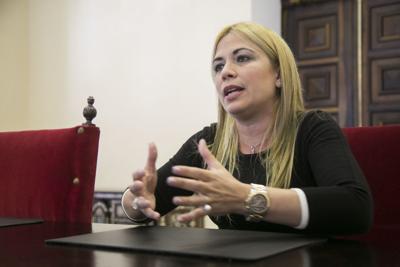
The recently designated executive director of the Autoridad de Carreteras y Transportación (ACT) de Puerto Rico, Rosana Aguilar, has declared new investments into Puerto Rico's road infrastructure, highlighting investments in maintaining current roads while improving their safety and expanding bridges. Puerto Rico's infrastructure from the grid system to road management hasn't performed well but perhaps it could be better under this new leadership.

Rosana Aguilar
El Vocero (Rosana Aguilar)

Many roads in Puerto Rico have no guard rails in dangerous areas, such as small roads or along a mountain pass. Especially, after the bombardment of Hurricane Maria, and other major hurricanes and tropical storms, the wear on the roads crumbles their foundations leaving quite a large bill for residents in Puerto Rico. Although still struggling to maintain their public debt on the island, Puerto Rico has made strides in seeking sustainable green alternatives of energy, and are looking at improvements for the island that will benefit the nation and Puerto Ricans for years to come. These investments in road infrastructure will see improvements in guard rails for safety, modernized on-ramps and off-ramps, and repaved streets.

Other minor improvements would include improved road signs, updated intersections, new reflectors, etc. The agency is expecting this to be completed at the scheduled days of roughly 450 days. Construction will begin in Puerto Rico from 8 am - 4 pm, Monday through Friday, with an alternate schedule over the weekend. Aguilar has been confident and grateful that the Governor of Puerto Rico, Ricardo Roselló, has been willing to work so eagerly on improving the island's infrastructure. Puerto Rico infrastructure looks poised to make a strong comeback, but hurricane season is just around the corner!

Will you be vacationing to the island anytime soon?